Showing posts with label Tocino. Show all posts

Tuesday, September 24, 2013

Crossroads of Europe

The key to financial security in the Middle Ages centered around control over the trade routes of Europe. There is no better example of this in Bellinzona where the Duck has led us this morning. First established in 5500 BC, control over the valleys leading North out of Italy was much contested and resulted in the building of Castelgrande in the 14th century. Overshadowed by the castle Montebello on a hill 300 feet above the city, ramparts and gates literally sealed off any movement North and South. In short, you had to pay the piper to be able to trade along this route which opened Europe to the Mediterranean.


The hillside with views of the fortifications

Bellinzona as seen through the ramparts of Castelgrande

During one of the periods when Milan fought and controlled this valley, Sasso Corbaro was constructed, adding another imposing castle structure 750 feet above the city itself. Coupled with Castelgrande, these fortresses extended walls reminiscent of The Great Wall of China with room to ride horses to deploy against any attacker. With the exchanges in control, the arts, culture, traditions, food and the economy flourished with a variety of influences from Baroque to Baronial. The sunny side of Switzerland was a key factor in the eventual development of the European continent as we know it today.


We enjoyed perfect weather to wander around Castelgrande and discovered several school groups doing the same. 


Grapevines planted along the stone walls

Viewing the modern city from openings in the thick stone walls.


Because the three castles together are a UNESCO World Heritage Site, great care has been taken to preserve the castles, and yet integrate them into the more modern city of Bellinzona. The result is a sometimes jarring juxtaposition of a medieval castle with an ultra modern outdoor event space used for concerts and other gatherings. 


In order to install elevators to make the site handicapped accessible, this shaft was drilled into the rock.
City planners even managed to build a modern parking garage and feature the ancient foundations of the castle as part of the architecture!


This short video features aerial shots of the Castle which really give you a sense of the scope of the fortification.


After touring Castelgrande and its ramparts, a leisurely lunch at the Migros left time for shopping and sightseeing in the old part of Bellinzona. Tucked in among the many delightful shops, Peggy finally found fabric to make the kind of lace curtains we had seen in many windows of chalets throughout Switzerland. It was a difficult choice between two beautiful patterns, so we bought both! They now adorn windows upstairs in our home, reminding us each day of our honeymoon trip.


Our curtains


But we had more to see! Part of the development of the "Crossroads of Europe" is the new Gotthard Base Tunnel where the Duck led us for a private tour of the AlpTransit Control building. Amazing is most likely an inadequate word for this new Wonder of the World. The Gotthard Base tunnel is the world's longest railway tunnel composed of two 57 kilometer-long tubes connected by cross tubes every 325 meters. With all the cross tunnels and shafts, emergency exits and stations, the complex is over 152 kilometers of the most modern system in the world.


Still under construction, the visitor's center is a marvel all its own


The walls are filled with rock excavated in the digging of the tunnel

Almost completed, when open, the Gotthard system will quadruple the traffic into and out of Northern Europe with trains running every three minutes under computer controlled directions from the AlpTransit control building. Built to last 100 years, the system is the result of modern technology with two special boring machines built solely for this undertaking. Aided by satellite-based engineering, the tunnel sections constructed over 4 years have only a deviation of no more than 137 millimeters over the entire length.

The final connection is made:


We also had another reminder of how seriously the Swiss take the protection of the environment from the perils of global climate change. Knowing that climate change threatens the very core of the Swiss economy, they recognize that transportation using more environmentally friendly methods like electric trains rather than that which burns fossil fuels will both preserve the natural beauty of the Swiss Alps and create revenue.

The engineering involved was astonishing, but it was simply one more example of the Swiss perspective on problem-solving. Why let a little thing like the Alps stand in the way of progress? No problem! We'll just dig a hole right through them! No endless debates from politicians--just a recognition that it needs to be done, and therefore we will find a way to do it.

So we end the day where we began: the key to financial security in the future is to control transportation across a difficult terrain. Then it was Castelgrande; today it is the Gotthard Base Tunnel. 

The following is a short video produced by AlpTransit, the corporation responsible for the Gotthard Tunnel:


We board the Postal bus to Biasca; a train to Bellinzona; and a train to Locarno. Upcoming will be the last stop of our journey to the high fashion and high society resort of St. Moritz before our return to Zurich and our flight home.

Today's trip:


View Larger Map


Friday, September 20, 2013

Mama Mia!

Everyone is gathered around luggage in the foyer of the hotel. Today, the duck is leading us across the top of the boot of Italy and there is no time to carry baggage with us, save for backpacks and personal items. After considering the physics of cramming all our bags into one van, our luggage is being transported by vehicle across the land route to our destination: Locarno, the Italian part of Switzerland. As was often the case when it came time for "luggage loading," David was front in center to help with the organizing!


David considers which bag should go in next

The journey from Brig takes us through the Simplon Pass tunnel (quite long and steep) to Domodossola, Italy. It's raining off and on which seems to fit the countryside. Gone are the bright colors of tidy houses, castles and streets, replaced with green vines, chipped ceramic tiles, and heavy vegetation.

Descending stairs to the tunnel for the connecting Centovalli train to Locarno, a cold wind greets us along with two cog train cars with seating arranged as if the design came after a motor and wheels were laid down first - almost an afterthought. Some seats were low; some high on a platform; and then low again further into the car. Even the horn, when sounded, didn't seem to have the deep, bass-throated tone of Swiss engines.


Santa Maria Maggiore is in the heart of the Italian portion of today's journey


Centovalli means "Hundred Valleys," and although we had seen so much gorgeous scenery already, the lush valleys with their steep drop offs and the rail bridges that helped us navigate these valleys still took our breath away.


We also noticed that in populated areas, every square meter of land was cultivated, often with neat rows of grapes. The Centovalli is the breadbasket of this part of Switzerland, and there were crops growing in even the smallest, steepest fields.


Image from myswitzerland.com

Climbing through the valley towards Locarno,  the landscape seemed somehow misplaced. Tight curves and steep drop-offs were the order of the day. At the top of the valley was the divide between countries. Here we exchanged our Italian crew for a Swiss one. The overcast skies brightened and even the trees seemed to sing out "alles in ordnung" as we descended into Switzerland once again. As David noted to everyone's amusement, even nature was a little more orderly once we left Italy.


With its lush palm trees and flowers, it seemed far from what we thought Switzerland would be.

At noon, after a "brief 10 minute walk, slightly uphill" and including a stop under a church portico because of a rain shower, we arrived at the Hotel Camelia. Here, pale yellow stucco walls, gardens with roses and pergolas with flowering vines, rooms with balconies and potted plants gave off an air of relaxation and welcome. Checking in and lunch in a bright, airy dining room gave way to free time to explore the sights and shopping in Locarno.


Our first rain!


By now, the walk down to the heart of town and the subsequent return back uphill seemed commonplace, as if we were Swiss ourselves and this was the normal progression of things. So too, was the interaction with shopkeepers; a combination of German, Italian, French and sign-language once again resulted in both happy customers and happy salespersons. 


Downtown Locarno

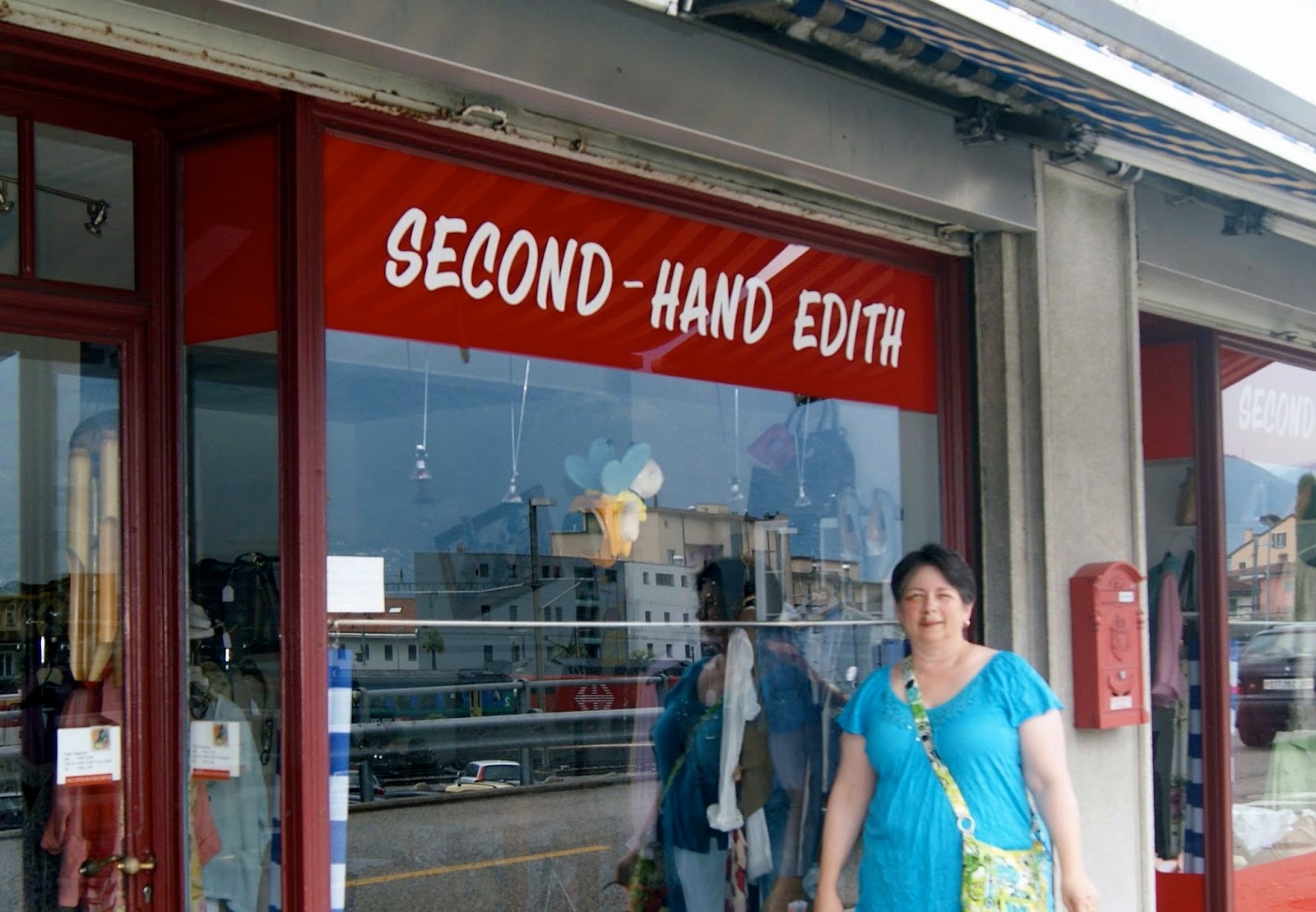
We had been looking throughout our trip for the Swiss equivalent of a thrift shop or flea market, and we were almost successful this day. Sadly, Edith's was closed.


Conveniently, half-way uphill was a small bistro with indoor (out of the weather) and outdoor (pleasant and sunny) tables where a liquid libation made the journey back and forth most pleasurable.

The afternoon lecture by Julie Guidotti covered everything you wanted to know about Tocino - the Italian part of Switzerland. This was in preparation for tours the duck would lead us on the next dayto the old part of town and a quaint village of Sogogno,  with its Museum of Valle Verzasca.

The evening meal took on a slight Italian flair, without the spaghetti and meatballs often envisioned by Americans. A tasty salat, zuppa, and pesce with root vegetables graced our tables along with a light white vino. Bon Appetite!


Heartier souls could descend the hillside once again to enjoy a walk around the lake before retiring. Tomorrow's tours would include an "E Ticket" bus ride on narrow mountain roads.

Today's trip:


View Larger Map
This short video gives you some idea of the scenery as we made our way across Italy and back into Switzerland again.