Monday, September 9, 2013

Castles and Climbers

After the usual delightful Swiss breakfast and a short talk about "The Simplon Pass" which connects northern and southern Europe, we followed the duck literally next door to Stockalper Castle. 


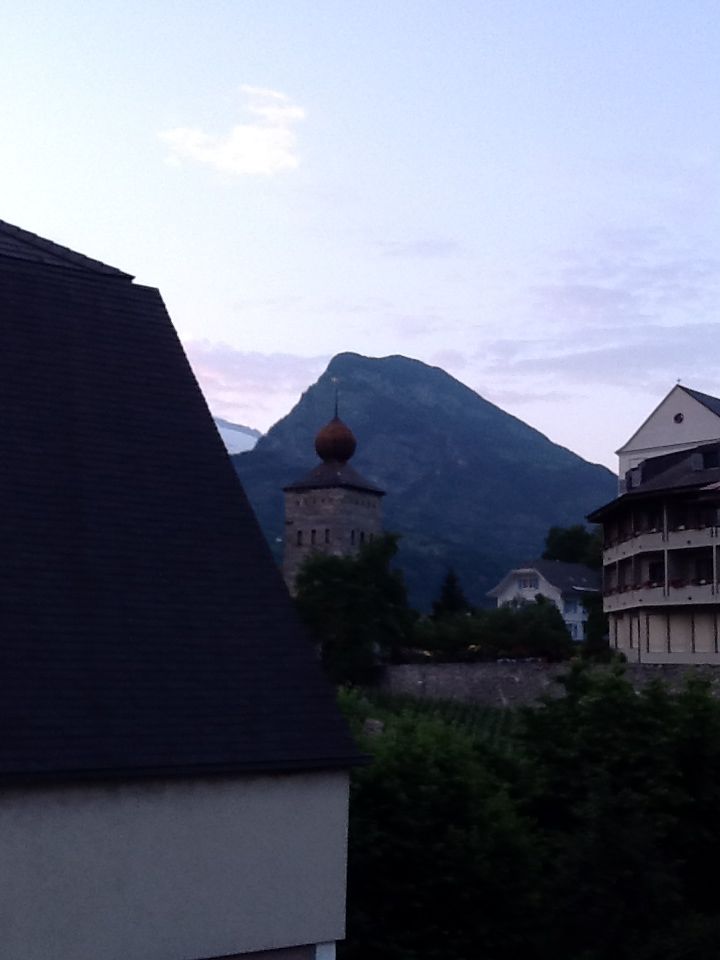
View of Stockalper Castle from our hotel

Constructed between 1658 and 1678 by Kaspar Stockalper, the structure was the largest example of private construction in Switzerland at the time.


Internal courtyards


At the time, castles and wayside inns provided shelter, food and a trade route to those travelers along the mountain pass (Simplon) connecting Italy and the Mediterranean with the rest of Europe. Stockalper, a silk merchant, took full advantage of his position on the Simplon pass to control and profit from any traffic across the route, and became one of the wealthiest men in the area because of it.

Later, Napoleon even constructed a military base, "Alte Kaserne," along the route not only to protect this national road, but to provide a resting place for merchants traveling this often difficult pathway. Fortunes were made and cities, like Brig, began to flourish as improvements made passage possible even during some winter months.


Stockalper Castle is a fine display of the wealth and life during those times with ornate wrought iron gates, courtyards, an ornately decorated chapel, and city administration rooms heated by tiled stoves which could be stoked from an adjoining hallway without disturbing the business of the day being conducted inside. Art, hand-painted wallpaper and solid hand-crafted wood furniture adorns the castle rooms still in use by city officials today.


Chapel Altar Highlighted with Silver

Hand Painted Wallpaper 


Peggy really liked the wallpaper!

Mid-morning, the duck once again led us to the Bahnhof for the train to Zermatt at the base of the Matterhorn. Small wonder (no pun intended) that Disney chose this breathtaking peak and surrounds as the basis for his commercial enterprise. The cog train we rode made its way higher and higher through the valley alongside flowing waters, stands of trees, dottings of houses and pastures. 


Arrival at Zermatt started a "short walk, slightly uphill" past shops and restaurants to a most beautiful "Kirche" (church) 


which also holds a graveyard for climbers who died attempting to reach the summit of the Matterhorn. Often, bodies had to wait to be buried until the Spring thaw came.


The flowers are Edelweiss


Walking through the village paths, we stopped for a lunch of local dishes at Cafe Fuchs and readied ourselves for the underground railroad trip to Sunnegga, with its view of the Matterhorn. 


The oldest structure in Zermatt

Cars are not permitted in Zermatt

Our lunch of salad and cholera


This train is not really a train at all. Think of an incline funicular like the gentle ones in Pittsburgh, PA that take you up the hillsides to view the city from its heights. Now throw that image out of your mind completely.

Funiculars use gravity to propel two cars past each other up and down a hillside. The same is true for the inclined railway taking you to Sunnegga - only more like something built at Cape Canaveral. Starting at 1620 meters in Zermatt, the duck leads you through a tunnel inside the mountainside to a waiting set of seats inside the car reached by climbing concrete stairs. Each car holds three seated and two or three standing passengers. Looking up the stairway, you see nothing but rails and lights disappearing at an absurd angle to somewhere up there at 2288 meters. It's the ride of your life and once underway, you reach the top in just 90 seconds.


That's 5259.61 feet to we Americans!

Going Up!

The view from the top of the car to the bottom

Catching our breath and wondering if we left vital organs somewhere down below, we are greeted by bright sunshine, blue skies, puffy clouds and a chalet with seats and tables with a most spectacular view. From Sunnegga, ski lifts and hiking paths lead off to higher climes. We had a perfect day to shoot photos, get sunburned if we weren't careful, and enjoy a brief aperitif and the scenery.

And now, we are going to post a ridiculous number of pictures of the Matterhorn. It's just too beautiful to choose just a few:


Can you see the tiny weather station all the way at the top?


Sometimes you just need to take a LOT of pictures. This was one of those times.


We ALL had the same need to take pictures

We took pictures of each other too!

The trip back was a letdown - only in a small literal sense as we "dove back down" to Zermatt in 90 seconds and took the train back to Brig descending through some of the most beautiful scenery in the world. It's hard for both your brain and your eyes to take it all in. 

On arrival back at Brig, we boarded a small tourist train on tires for a guided tour of Naters and Brig pointing out various historical sites and ending up, thankfully, just a few yards from our hotel. The weather up in Zermatt had been perfect, but Brig, in the southern part of Switzerland, was experiencing a record-setting heat wave, with temperatures above 90 degrees!


OK... one more picture of the Matterhorn

Our evening was capped off with another group dinner of local fare at Restaurant Schlosskeller. An evening talk on legends of the Valais area was given by our local guide, Mrs. Beatrice Wust. Tomorrow: ITALY.

The following video of Zermatt and the Matterhorn is beautiful...


Wednesday, August 28, 2013

A Taste of the Alps

This morning the duck is headed South, as all ducks are wont to do and we followed it to Interlaken West train station. Smart ducks conserve their energy and take the Golden Pass Train to Zweisimmen. Climbing out of the Simmental Valley, we arrive at Zweisimmen nestled at 4,000 feet in between some high mountain pastures. Boarding a small bus almost as wide as the road leading up a series of switchbacks, we're headed to a typical Alpenage, a Swiss Alp cheese dairy.


We can see the village far below


The air changes; it's a bit cooler than the valley although the bus interior seems to have brought along some of the heat from down below. A bright sun and the sound of cow bells greets us as we arrive at the summer pastures, wood-framed buildings and barn that marks our destination. The view is everything one would imagine. Across the valley, the other mountainsides are dotted with small buildings and pastures rising up to some snow capped peaks. There is even a glacier in the distance.


Our hosts for the tour today are a rosy-cheeked young woman whose boyfriend is the chief cheese maker, along with his mother, her sister and her sister's boyfriend who all tend the cows from early spring until early fall. When winter comes, and the upper pastures are snow covered, she is the receptionist at a ski school, and he is a ski instructor.


In the old days, the cows were herded up and down the mountainside, but modern times and machinery have changed all that. Cows are now given a lift by truck to save time and precious energy; they're here to graze on herb pastures and produce milk for some of the best cheese in Switzerland. Each of the decorated cow bells hanging from the rafters represents a prize winning cow.


Our guide explains that 9 to 12 hour days are the norm during their stay here, bringing cows in; milking; letting them out; making cheese; feeding the swine (who eat the whey produced - nothing goes to waste here); and conducting the occasional tour. They also rent out the building for weddings.


The cows have their tails tied to keep them out of the way when milking


It's a combination of both modern and primitive with well-worn timbers and spotlessly clean machinery coming together to produce stacks of cheese rounds aging on wooden racks in cool rooms. Part of the daily ritual includes the turning of the wheels of cheese as they age and marking their progress.


Mountain air gives you an appetite. Lunch today, made by the alpenage hands starts with fresh salad, a local wine and a local soft drink that tastes a little like ginger ale, potatoes and a delicious cheese known as "Raclette." 


The cheese is melted from large blocks under special heaters and scraped off onto your plate just before becoming burnt. It has a unique taste stemming from the pasture with its herbs that the cows eat.


Special warming units for preparing raclette.

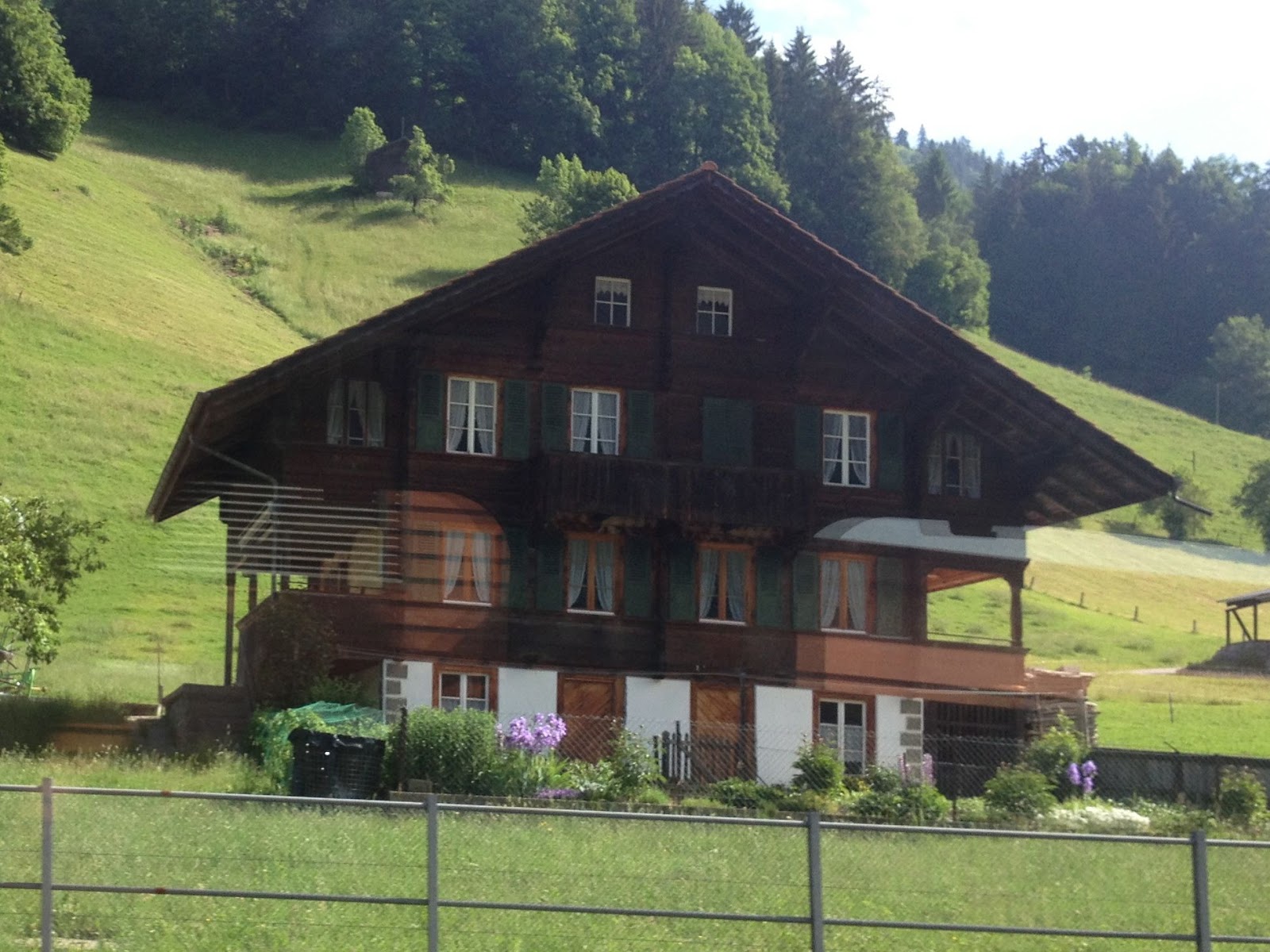
After lunch and a few more pictures, it's back down the mountainside to catch the next train to Montreux. We're winding our way across one of the passes and enjoying the view as we leave the German-speaking part of Switzerland headed for the "Swiss Riviera." French is spoken here and gray stone houses slowly replace the half-timbered woody German-style chalets. The mountains are jagged and are called dents, the French word for teeth. 

Breathtaking views include deep gorges and valleys prompting one in our group to ask "how far down is it?" The reply from Andrea is swift and to the point: "In Switzerland we say it is two meters down and then Eternity."


At last, the hillside gives way to breaks in the trees for brief glimpses of  the Western end of Lake Geneva and the town of Montreux. Palm trees at the station where we change trains let us know that the weather is influenced by the Mediterranean. We also arrived in the middle of a heat wave and discovered the temperatures in the 90s!


We didn't expect palm trees in Switzerland!

This is the only station in Europe with three different rail gauges; regular, narrow for crossing the mountains and very skinny (the Rochers de Naye train) taking visitors to a nearby peak. We're on our way to our final destination for the day, Brig.

On arrival in the early evening, a wide avenue greets us outside the station where the duck leads us on the usual "short walk, 10 minutes, slightly uphill" through the heart of the city to our hotel. Rooms at the Schlosshotel, Art Furrer, either overlook the small park outside or the snow capped mountain that stand between us and the top of Italy.


An evening meal with salads, a delicious carrot soup and a choice of entree topped of with glasses of Coca-cola with real ice and good conversation rounds out our day before bedtime.


After a very full day, the duck is dog tired.

Maybe you will have enough energy to watch this short video about Swiss "cow culture."